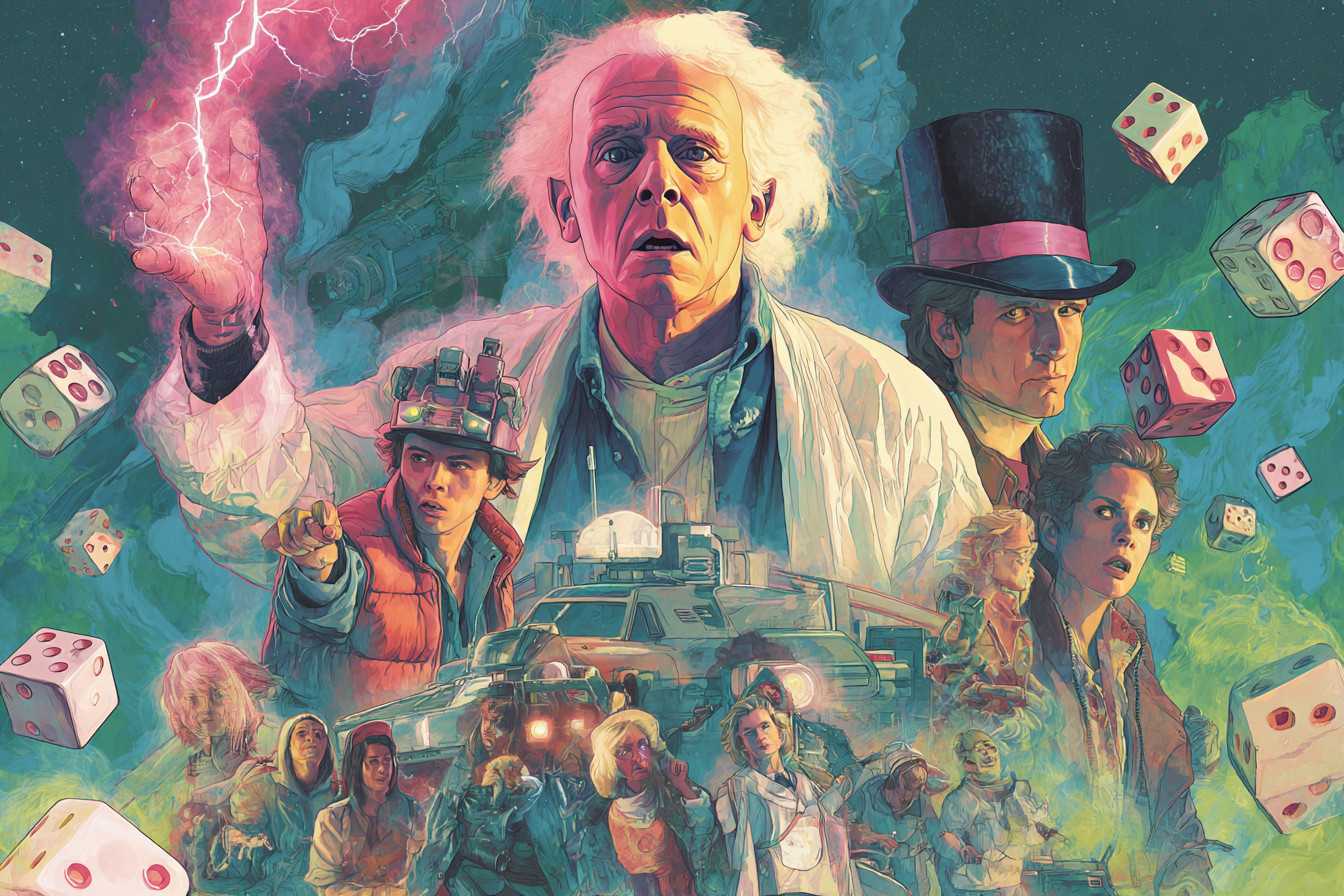

Back to the Future: Dice Through Time At A Glance
| Aspect | Details |
|---|---|
| Designer | Nathan Hajdu |
| License | Back to the Future |
| Year Published | 2016 |
| Play Time (Solo) | 45-75 minutes |
| Complexity | Medium |
| Recommended Age | 14+ |
| Our Rating | 10/10 |
Back to the Future: Dice Through Time is a game about keeping paradoxes at bay. Players navigate the time line — making sure historic events happen properly and preventing the collapse of the timeline. This is cooperative (not competitive) vs. the chaos of the time line.
I have played it 34 times. I know which parts of the timeline will hurt you the most. I am knowledgeable about probability distributions for dice outcomes. I have played enough that I can see the beauty in the time travel theme underneath the puzzle.
What I find intriguing about this game — it treats the Back to the Future time travel premise seriously. Time travel is not just decorative — time travel is a part of the mechanical structure of the game. Decisions made in 1955 have a bearing on what you can do in 1985. Paradoxes have mechanical consequences. Historic events matter — because they represent the rules of the timeline itself.
How you design a licensed game — the license is the concept. You build the entire mechanism to reflect the concept of the license.
What Back to the Future: Dice Through Time Really Is
Players are navigating the Back to the Future time line — attempting to keep key events happening as they are supposed to. To get to specific years, players need to land the DeLorean in the correct years. Players need Marty and Doc to be in the right places. Specific events need to occur to keep the time line intact.
The central mechanic is dice rolling modified by resources. Players roll dice to determine the results of their actions. Players can modify rolls using resources to create the desired outcome. Players are attempting to create situations where key events can occur successfully.
Players advance through the seven time periods that cover the three films. Each period has specific requirements that must be met. If players do not meet the requirements, paradoxes accumulate. When there are too many paradoxes, the time line collapses — and the players lose.
Players face an interesting puzzle — players have limited resources and limited dice rolls. Players must decide how to allocate those resources to create the optimal situation where key events can occur. If players fail to meet a requirement, they will have to deal with paradoxes for the remainder of the game.
Consequences Of The Timeline Flow Forward:
One thing that makes the design of Back to the Future so clever — is the fact that decisions made in earlier time periods have an impact on later time periods. For example, if a player does not manage to secure that George and Lorraine fell in love in 1955 — that event creates a paradox that can damage their time line stability later in the game.
The game forces players to consider the causal relationships between events that take place at different points in time. This is true mechanically — as well as thematically. Back to the Future is a story about the nature of causality — and how small changes can create chain reactions of effects. The mechanics of the game mirror the themes of the films.
I once played a game where I took liberties with the events in 1955. I assumed that I would be able to miss some timeline events — and that I could make up for lost time later. However, by the time I reached 1985, I had created so many paradoxes that I was unable to recover. What was originally a viable time line had become completely unworkable by the end.
That game taught me something important about traveling through time — you cannot simply ignore the consequences of your earlier actions — and try to fix them later. The time line works in such a way that the damage caused by your earlier neglect will continue to grow and create additional problems.
Giving You More Control Over Dice Rolls
Most games that involve dice-rolling seem to rely solely on chance — you roll the dice, and you hope for the best. Back to the Future gives you the ability to mitigate the randomness of the dice through the expenditure of resources.
Each turn you roll dice to see what options will be open to you. After that, you spend resources to alter the dice — changing a 3 to a 5, combining dice, re-rolling etc. The question becomes — where should I spend my limited resources to create the outcomes I need?
This allows for real decision-making — despite the presence of dice. You are not fighting against chance — you are working within chance to achieve your objectives. That is a more compelling mechanical problem than either pure chance — or pure determinism.
I have lost games due to terrible luck with the dice. However, I have also lost games where the dice were fine — and I simply allocated my resources poorly. Those losses that hurt the most are the ones where I could have won — if I had used my resources better.
The DeLorean And Character Placement
The DeLorean is a shared resource that Marty and Doc use to travel through time. However, moving the DeLorean to the next year costs resources.
Additionally — Marty and Doc need to be in the correct location. If Doc is in the wrong year, he cannot facilitate science related timeline events. If Marty is in the wrong location, he cannot facilitate romance or action related timeline events.
This presents a logistical puzzle — you have limited mobility — and you need to place your characters in the correct locations to be available for timeline events as they arise. If you fail to place your characters in the correct locations — you may be unable to complete the necessary tasks.
I have played games where I failed to position myself properly in the beginning of the game — and spent the remainder of the game attempting to compensate. The placement constraint creates emergent challenges that are consistent with the theme — you are literally managing when and where key figures in the story are available.
Scoring Mechanic & Difficulty Scaling
There are multiple difficulty settings for Back to the Future based on score thresholds. Easy Mode asks you to reach a minimum score. Medium Mode asks for more. Hard Mode asks for even more. Very Hard Mode asks for nearly perfect play.
The scoring mechanic rewards successful timeline completion and paradox prevention. Players earn points for successfully completing timeline events. Players lose points for creating paradoxes. The game encourages both success — and efficiency.
I primarily play on Normal/Hard difficulty. Easy Mode is trivial after you learn the systems. Hard Mode is difficult — but winnable with optimized strategy. Very Hard Mode is brutal — I have only beaten it two out of a dozen attempts.
The difficulty scaling is well done. It allows for gradual increases in challenge — rather than an all-or-nothing approach to winning.
Thematic Accessiblity
Back to the Future: Dice Through Time is a relatively simple game compared to others on this list. The theme is accessible. The rules are easy to follow. The dice-rolling creates familiar decision-making.
However — the theme is not trivial. The mechanics of time travel — and paradox management — are a part of the core conflict in the films. The placement of the characters — and the timing of the events — matter because these elements contribute to the story of the films.
This represents the sweet-spot for licensed games — mechanically accessible — yet thematically rich. Players do not need to have an understanding of complex systems to participate. Yet — if players have knowledge of the film franchise — they will appreciate how the mechanisms of the game express the essence of the franchise.
Solo Scaling & Accessibility
Back to the Future is designed to be cooperative. In solo — players control both Marty and Doc. Because of this — no advanced AI is required — since players are controlling all aspects of the game.
Game length is reasonable — 45-75 minutes, depending on difficulty and how much players choose to optimize. Compared to many of the larger games on this list — this is a relatively short amount of time. Players can play a complete game — and still have plenty of time to enjoy the rest of their evening.
Setup time is approximately 10 minutes. There is little overhead for the rules. It is possible to teach a new player the basics in 10-15 minutes. The game is accessible to new players — yet offers enough complexity to engage experienced players.
Does Back to the Future Still Have Value?
The game was released in 2016. It is now 2026. Since the release of Back to the Future — several time–travel themed games have released. Some of these are excellent. However — none have achieved the same level of integrating time travel mechanics — and themes — as Back to the Future.
Components are fun — illustrations that evoke the spirit of the films — tokens that are clearly defined — recognizable locations from the films. The rule book is well organised — and easy to follow. The game is presented with warmth — without being overly cute.
The one criticism I have — the game is mechanically simpler than some players may prefer. If you desire games with high optimization — this is not that game. If you desire a time–travel puzzle game that is accessible — this is an ideal choice.
Why You Should Play This As A Single Player
If you are a fan of the Back to the Future films — this game is a great fit. It is a time–travel game that makes sense — and is mechanically interesting.
If you desire a game that respects the original license — but is not overly complicated — Back to the Future demonstrates how to balance theme — and mechanics.
If you are seeking a single-player experience that does not require a lot of rule-study — this is an option that is accessible — without being too trivial.
If you are interested in understanding how dice-rolling can be meaningful — and not random — Back to the Future shows how resource allocation can provide agency — in an environment of randomness.
If you are introducing a friend to modern board games — and that friend enjoys Back to the Future — this is an excellent introduction to modern board games — without overwhelming.
Conclusion
Back to the Future: Dice Through Time is a 10/10 licensed experience — that is accessible. The time–travel mechanics are fitting to the theme. The consequence system creates meaningful decision-making. The difficulty scaling is well-suited for solo players. The solo experience is enjoyable.
I have played 34 games of this — and I continually return. I want to be able to conquer Very Hard difficulty every time. I want to experiment with various methods for placing my characters. I want to optimize my resource utilization. The game provides sufficient depth for continued engagement — and is mechanically accessible.
This game illustrates that licensed games — do not have to be complex to be good. Treat the original material with respect. Develop the mechanics to illustrate what makes the IP unique. Avoid unnecessary complexity. Back to the Future achieves elegance through simplicity.
If you wish to experience a Back to the Future experience — this game will give you the Back to the Future experience — in a package that honours the spirit of the original material.

Nicholas teaches secondary school history by day and campaigns through fantasy worlds by night. He writes about legacy and campaign games—the epic, months-long sagas that build friendships, stories, and the occasional scheduling nightmare.