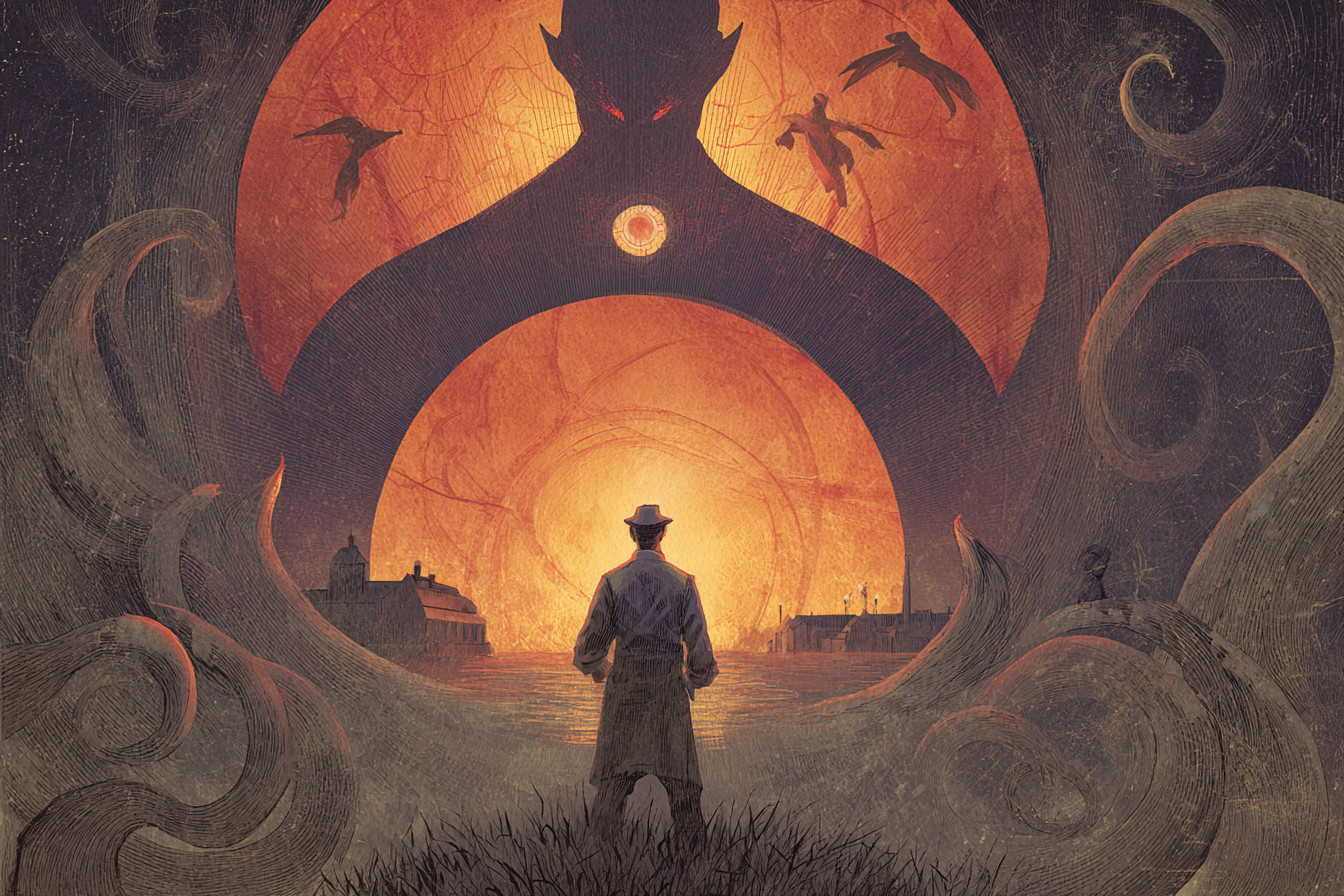

Eldritch Horror At A Glance
| Aspect | Details |
|---|---|
| Designer | Kevin Wilson |
| License | Lovecraftian/Cthulhu mythos |
| Year Published | 2013 |
| Play Time (Solo) | 90-120 minutes per scenario |
| Complexity: | Medium-Heavy |
| Recommended Age | 14+ |
| Our Rating | 10/10 |
Eldritch Horror is a game in which you are investigating cosmic horrors you cannot comprehend. You are traveling around the world, exploring different locations, finding clues, and eventually learning that the situation is more serious than you originally thought. Ultimately, by the last scenario, you will either stop an ancient being from waking up or try to limit the destruction as the fabric of reality unravels.
In addition to playing through many different complete campaigns — investigating various ancient beings at different times and places — I believe each campaign will have its own uniqueness due to the large size of the location deck, the variety of the encounter deck, and the different investigators will have experienced different types of narratives.
One thing that I believe is significant to Eldritch Horror — it is a game about the development of information over time. At the beginning, you are in ignorance. Over time, you gain insight into what you are dealing with. That insight is horror. Not, typically, jump scares, nor combat, but rather the realization that you are dealing with something alien and unknowable.
Lovecraftian horror, in the form of a board game — this is what Eldritch Horror does very well.
What Eldritch Horror Really Is
You are investigators in the 1920s, attempting to prevent cosmic horrors from destroying the world. You are traveling to different parts of the world — to Egypt, Japan, Antarctica, and to London — collecting clues and investigating mysteries. Along the way, you will experience some odd occurrences; your investigators will suffer from trauma; and reality will begin to break down.

There is a central threat in the game — an ancient being that is attempting to wake up. The task of the investigators is to collect enough clues to shut off the gates before the entity wakes up completely. If the investigators successfully close the gates, then the entity is locked away. If the investigators are unsuccessful in shutting off the gates, the entity awakens, and the investigators must attempt to mitigate the amount of destruction caused by the entity.
The fundamental mechanism of the game is the investigative mechanism. Investigators travel to different locations. Investigators experience different situations. Investigators solve mysteries — using the investigators’ skills or items they have acquired — in order to obtain clues. When they successfully resolve a mystery, they receive new clues toward resolving other mysteries. When investigators fail to resolve a mystery, they incur trauma — either physical or psychological. When investigators have collected sufficient clues, they advance toward the goal of shutting off the gates. However, when investigators have accumulated too much trauma, they become incapacitated.
This creates a push-pull between investigation (in order to collect clues and to shut off the gates) and the accumulation of trauma (which occurs when investigators experience cosmic horror, or when investigators engage in combat with monsters). If investigators push too hard to investigate, they may become overwhelmed by the sheer quantity of trauma they have incurred, and become incapacitated. On the other hand, if investigators do not investigate aggressively enough, they may not collect sufficient clues to shut off the gates before the entity awakens.
Trauma as a Mechanic to Tell Story
Trauma is used as a mechanic in Eldritch Horror to tell the story of investigators encountering cosmic horror. When investigators encounter cosmic horror, they incur psychological trauma. When investigators fight monsters, they incur physical trauma. When investigators have accumulated too much trauma, they become incapacitated.
However, the key — trauma is not merely a damage track. Trauma represents the mental state of the investigators. As investigators incur more psychological trauma, they are describing what they are experiencing as investigators. They are seeing things that cannot be rationally explained. They are learning that the world is not what they previously believed.
As the game progresses — particularly by the middle of the campaign — the investigators are visibly traumatized. They have seen too much. They know too much. Some investigators become paranoid. Some investigators have nervous breakdowns. Some investigators are simply broken shells of individuals who are attempting to complete their final mission before they totally lose their minds.
I recall one campaign where my investigator was researching an entity connected to the realm of dreams. Almost all of the encounters in this campaign resulted in psychological trauma. By the midpoint of this campaign, my investigator had suffered so much psychological trauma that they were only one point away from becoming completely insane. I was frantically working to complete the final research before my investigator went crazy.
It is this type of tension — both mechanically and narratively — that creates the magic of Eldritch Horror.
Escalation of Fear & Location Encounters
The location deck in Eldritch Horror is massive. There are hundreds of encounters across dozens of locations. Each location has encounters unique to that location. For example, Antarctica feels different than London, which feels different than Arkham.
Additionally, the encounters in Eldritch Horror escalate in fear. Early encounters in the game are generally mysterious but can be resolved without major issue. You discover strange artifacts. You learn disturbing information. Mid-campaign encounters in Eldritch Horror are frighteningly deadly. You fight monsters. You observe cosmic phenomena. Later encounters in Eldritch Horror are apocalyptic. The rules of reality are falling apart.
The progression of the encounters creates an emergent narrative. You are not experiencing a fixed narrative. You are experiencing a story that emerges as you progress through the encounters. Additionally, the escalation of the encounters is real — the late game encounters in Eldritch Horror are mechanically much more challenging to resolve than earlier encounters, requiring either greater skill, or the purchase of greater numbers of items.
I have had campaigns where I was completely misinformed about the nature of the threat until the late game. I thought I was fighting one kind of horror, but it turned out to be a completely different type of horror. This realization created a true sense of shock because I was preparing for the wrong type of threat.
Awakening Track for Ancient Entity
In addition to the mechanics described above, Eldritch Horror includes an awakening track for the ancient entity. As the investigators fail to make progress toward the closure of the gates, the ancient entity grows closer to waking up completely. If the awakening track is filled completely, the entity will awaken. At that point, the investigators will transition from a prevention mindset (closing gates and acquiring clues) to a mitigation mindset (attempting to limit the damage the entity causes as it destroys the world).
The awakening of the entity is a pivot in terms of victory conditions. Prior to the awakening of the entity, the investigators are winning by closing the gates and acquiring the necessary clues. Following the awakening of the entity, the investigators are winning by defeating the entity in the final combat (which is extremely difficult), or by acquiring the necessary number of dominion tokens (acquired through investigation) to seal the awakened entity.
This creates pacing within the game. Early game is preparation. Middle game is increasing tension as the investigators work against the clock to acquire the clues needed to close the gates prior to the entity’s awakening. Late game is either triumphantly sealing (if the investigators were sufficiently advanced), or frantically attempting to survive as the entity awakens and begins to destroy the world.
I have had campaigns where I was significantly ahead in terms of clues, thus preventing the awakening of the entity prior to its awakening. I have also had campaigns where the entity awakened, and I was forced to pivot from investigation to survival mode — mitigating the effects of the awakened entity’s destruction.
Both experiences were enjoyable. Both were engaging.
Mystery Solving Mechanics & Clue Acquisition
Mysteries represent the puzzles that the investigators must solve in order to acquire clues. Each mystery requires a specific number of clues. Investigators travel to locations that contain mysteries. When investigators resolve investigations at these locations, they earn clues that help them to solve the mystery. Upon successfully solving the mystery, the investigators acquire benefits (generally advancing the investigators toward sealing the entity).
However, mysteries can also create complications for the investigators. Some mysteries, upon successful solution, create events. Some mysteries, upon failure, create further complications for the investigators. The investigators must make strategic decisions regarding which mysteries to pursue, and when.
I have had campaigns where I concentrated my efforts on specific mysteries. I have also had campaigns where I divided my investigative effort among several mysteries. The strategic decision-making affects how the campaign plays out.
Is Eldritch Horror Still Relevant Today?
The game was first released in 2013. It is now 2026. Since its release, several Lovecraftian-themed games have been published. Arkham Horror: The Card Game (which is already included on the Solo Games Hub) provides a more intense experience. Several newer Cthulhu-themed games have been released since 2013. However, Eldritch Horror remains the most accessible entry point for players interested in Lovecraftian horror-themed games.
The components of the game are visually stunning. The artwork is evocative. The tokens are clearly defined. The board layout is functional. The rule book is comprehensive and organised. While teaching the game takes approximately 20-30 minutes (because there are many mechanics to teach), the fundamental loop of the game is straightforward.
My only criticism of the game — the game can be quite lengthy, and it can be frustratingly anti-climactic if the player(s) are sufficiently ahead in clues (the player(s) win before anything exciting happens), or if the player(s) are hopelessly behind (the player(s) know they have lost, but still have to continue playing out the remaining turns).
Setup & Accessibility
Setup of the game takes approximately 10 minutes. Players organise their investigators, set up the entity board, and shuffle the location and encounter decks. Setup is simple.
Gameplay lasts for 90-120 minutes per scenario. With multiple scenarios in a campaign, the overall length of the campaign can be considerable. However, individual scenarios are self-contained experiences.
Rules overhead for the game is moderate to high. Players are learning the mechanics of investigation, the mechanics of trauma, and the mechanics of resolving encounters. However, once players understand the basic loop of the game, the mechanics become intuitive.
Campaign Structure & Replayability
A complete Eldritch Horror campaign consists of three to five scenarios, in which the investigators are researching the same entity over multiple time periods. The entity changes over time. The story develops. The location deck changes based on the results of previous scenario resolutions.
Because the location deck is so vast, the game offers immense replay value. The combination of different locations, the variety of investigators, and the selection of different entities — each campaign will feel different.
I have completed dozens of scenarios, and have researched multiple complete campaigns. I have investigated multiple different entities at different times. The scenarios never seem to repeat themselves due to the variety of the encounter decks and the varying entity configurations.
Why You Should Play This Solo
If you enjoy cosmic horror and want to experience Lovecraftian terror through gameplay — then Eldritch Horror is a must-play.
If you desire a game in which the use of trauma mechanisms serves to illustrate the narrative — then Eldritch Horror demonstrates how a damage track can be used to convey a story.
If you prefer to experience gameplay that simulates the process of actual mystery solving — then Eldritch Horror provides that experience.
If you prefer to experience a cooperative game in which you are struggling to overcome seemingly insurmountable obstacles — then the entity in Eldritch Horror is almost always stronger than the investigators. Earning a victory is satisfying.
Conclusion

Eldritch Horror is a 10/10 cosmic horror experience. The investigative mechanics are robust. The trauma system serves the narrative effectively. The encounter design is diverse and immersive. The campaign structure creates sustained engagement.
I have played through multiple complete campaigns, and I am continuing to investigate further. I want to experience different combinations of entities. I want to see how different teams of investigators respond to the same terrors. I want to experience the full scope of the encounter deck.
This game illustrates that a licensed game can effectively encapsulate the emotional and thematic elements of its source material. Eldritch Horror does not merely include Lovecraftian themes — it mechanizes the aspect of Lovecraftian horror that makes it unique: the realization that you are confronting something fundamentally unknown and incomprehensible, and you can do little to counter that fact but attempt to endure.
If you want to experience cosmic horror and slowly lose your mind to eldritch knowledge, Eldritch Horror will deliver that experience entirely.

Nicholas teaches secondary school history by day and campaigns through fantasy worlds by night. He writes about legacy and campaign games—the epic, months-long sagas that build friendships, stories, and the occasional scheduling nightmare.