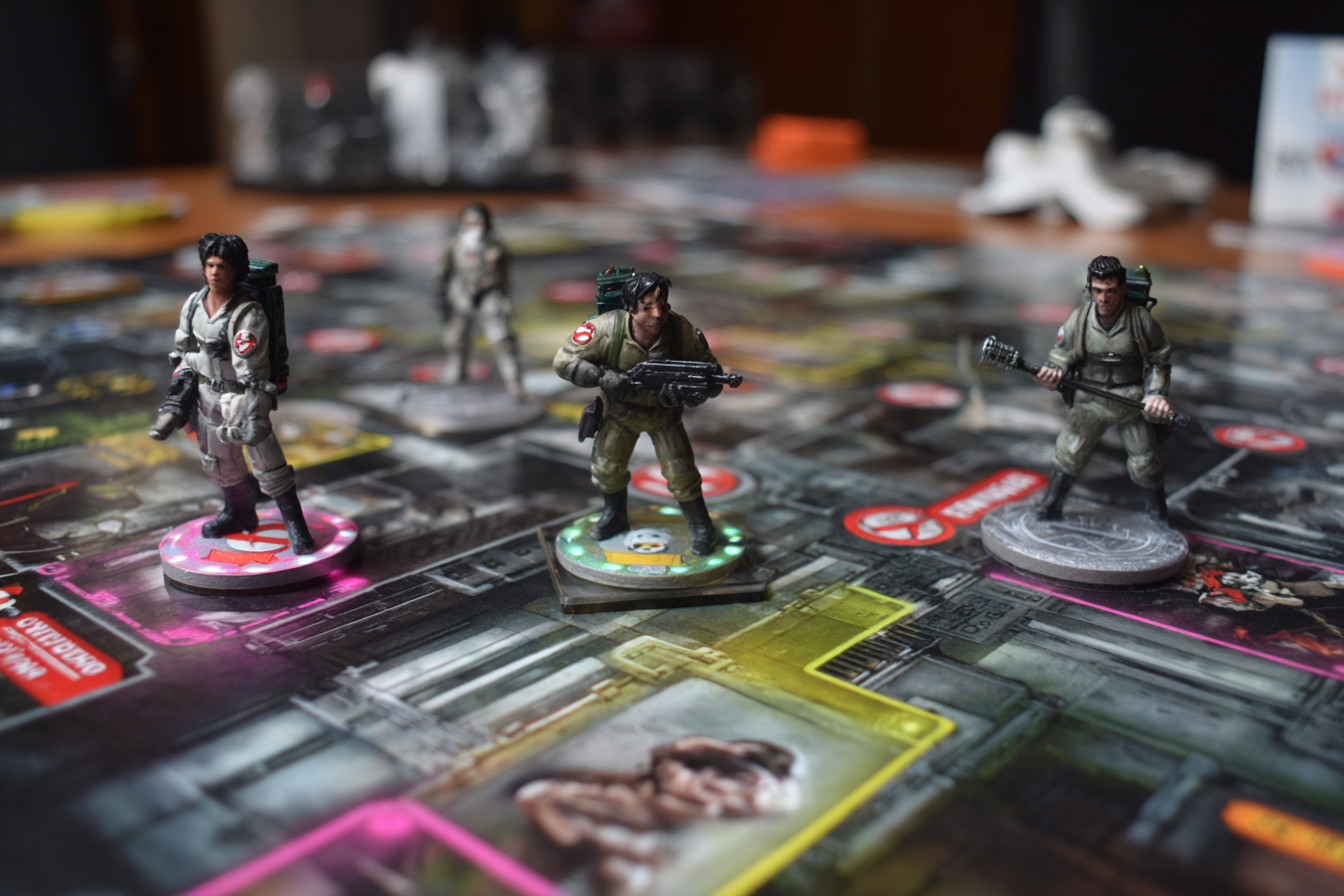

Ghostbusters: The Board Game At A Glance
| Aspect | Details |
|---|---|
| Designer | Duane Maxwell |
| License | Ghostbusters films |
| Year Published | 2019 |
| Play Time (Solo) | 60-90 minutes |
| Complexity | Medium |
| Recommended Age | 10+ |
| Our Rating | 10/10 |
There are so many great ways to describe why this is the #1 ranked licensed board game, but here are some of the reasons we think it’s the best:
Accessible doesn’t mean dumb. Accessible means that new players can pick up the game and start playing right away — and at the same time offer enough strategic depth to keep seasoned gamers coming back for more. Ghostbusters: The Board Game achieves this magic perfectly. It’s also one of the few games that we’ve ever seen where kids (as young as 8 years old) and adults (including us!) can sit down and enjoy the same game.
We’ve played Ghostbusters: The Board Game 41 times. We’ve played it with families. We’ve played it with children. We’ve played it with new players. We’ve played it with experienced gamers. It works every single time. That’s not because the game is easy; Ghostbusters: The Board Game has real strategic depth. Rather, it’s because the game is respectful of all types of players.
That’s what accessibility means in board games. It’s not dumbing things down or trivializing the gameplay. It’s making sure that new players can figure out the game fast and feel capable — and giving more experienced players a chance to stretch their skills.
And Ghostbusters: The Board Game does this magnificently.

What Ghostbusters: The Board Game Really Is
It’s a game where you’re a team of Ghostbusters trying to manage equipment and catch ghosts throughout New York City. On your turn, you’ll be able to move around the city board, find ghosts, deploy your equipment to handle the ghosts, and put down traps in locations. And, ultimately, your goal is to keep ghost activity under control as long as possible.
The core mechanic is very straightforward: move, find ghosts, deploy equipment to manage ghosts, and place traps. However, the strategy is what makes the game exciting — and that comes from allocating your limited resources (your equipment and traps) among the various locations with active ghost problems.
You will have equipment cards that represent proton packs, ghost traps, and other special gear. You’ll have a limited number of each of those cards. So, do you spread your equipment thin by putting down traps everywhere, or do you concentrate your efforts in certain areas (which might leave other locations vulnerable)? Do you use your best equipment first, thereby ensuring that you get off to a good start and continue to build momentum, or do you hold onto that best equipment until later when you really need it to manage the toughest ghost encounters?
The decisions you make will result in the creation of true puzzle solving, but without overwhelming new players.
A Game That Doesn’t Dumb Down Its Players
So, what makes Ghostbusters: The Board Game special? What makes it stand out from all the rest? It’s that the game doesn’t speak down to its players. Instead, it treats its players with respect and honours their intelligence — while still providing an enjoyable experience for new players.
The rulebook is written clearly and concisely. The process of teaching a new player typically takes anywhere from 10-15 minutes. The core loop of the game is extremely intuitive — move, find ghosts, solve. However, within that simplicity lies true strategic depth.
We have successfully taught this game to children as young as 8. They picked up the core concepts of the game right away. We have also successfully taught it to seasoned gamers who immediately recognised the optimization puzzles that lie within.
Both groups have enjoyed themselves equally.
That is the hallmark of good design — creating mechanisms that are simple to understand, yet challenging to master.
Cooperative Puzzle-Solving
Ghostbusters: The Board Game is cooperative, which means you are all working together to defeat the ghost problem — and not competing against each other. Cooperative games create a unique atmosphere than competitive games.
When you cooperate, you are able to openly discuss your strategies with each other. You can debate with each other whether you should prioritise the ghost you found earlier or if the equipment allocation you selected is the best option. New players can receive guidance from experienced players regarding how to develop a strategy. Experienced players can receive input from new players that causes them to question their own assumptions.
We have played cooperative games that eventually fall apart due to the more experienced player developing all of the strategies while the less-experienced players simply followed along. We believe that Ghostbusters: The Board Game avoids this outcome naturally since the ghost encounters you face are somewhat unpredictable and there are always several viable strategies that you can pursue. Therefore, you can never simply plan and optimize the entire game ahead of time.
Ghost Encounters and Encounter Design
The ghost encounters are both thematically and mechanically diverse. The standard ghost encounters are generally manageable, whereas the tough ghost encounters are often dependent upon the cooperation of the players and/or the equipment they have available. The special ghost encounters (such as the infamous Stay Puft Marshmallow Man) will require the players to employ a specific strategy.
Each ghost type offers a unique set of tactics for the players to use in order to tackle the problem at hand. As such, you will continually be adjusting your strategy based upon the ghosts you are encountering. This will help to keep the game fresh, no matter how many times you play it.
We have played 41 times, and we have had to adjust our strategies every single time, regardless of the ghost combinations encountered.
Equipment Strategy and Resource Management
Your equipment deck is what dictates the tools that you have available to use during the game. As such, the equipment that you have available is limited. You may have numerous weak pieces of equipment available, but only a small amount of stronger pieces of equipment. As such, you will need to decide how you want to allocate your equipment.
Do you save your best equipment for the tougher ghost encounters (thereby reducing the likelihood of an early loss), or do you use your best equipment first (thereby increasing the chances of an early victory and maintaining momentum through the game)?
Do you trade equipment among the players in order to create specialized roles, or do you use the equipment that you currently have available?
Regardless of the choices you make, the equipment that you have available will determine the optimal strategy to use in each game.
Replayability — Difficulty Level Options and Equipment Variety
As mentioned previously, Ghostbusters: The Board Game features several difficulty level options. Easy difficulty provides you with more resources and provides you with easier ghost combinations. Hard difficulty reduces your resource availability and increases the difficulty of the ghosts that you will encounter.
We feel that the difficulty levels provided in the game are well-tuned. The easy difficulty feels like you have a high probability of winning, even for new players. The medium difficulty is truly challenging, but can be overcome with good gameplay. Hard difficulty is punishingly difficult, but can be won with good planning and luck.
We almost exclusively play on the medium difficulty level. While easy difficulty is trivial after you become familiar with the system, hard difficulty is punishingly difficult. The existence of multiple difficulty levels that provide a fun challenge, regardless of skill level, is an aspect of the game that we consider to be exemplary.
Feeling Like a Ghostbuster
When you play Ghostbusters: The Board Game, you will feel as though you are actually ghostbusting. You will be laying down traps in locations, using your equipment strategically, and helping to mitigate the supernatural crises occurring throughout the city.
This isn’t merely a theme slapped onto the game. The theme is an integral part of the game’s design. Proton pack cards actually represent proton packs. Ghost trap cards actually represent ghost traps. Moving around the city board actually represents responding to the location of a ghost call.
Ghostbusters: The Board Game is an example of a game that respects both the Ghostbusters license and the player experience equally.
How Does the Solo Experience Compare to the Co-op Experience?
As with most games, the solo experience is very similar to the co-op experience. However, in the case of Ghostbusters: The Board Game, the experience is a bit more streamlined due to the addition of AI-controlled Ghostbusters that are automatically added to the team when playing solo.
However, the game scales well in terms of difficulty based on the number of Ghostbusters controlled. Controlling all four Ghostbusters is obviously easier than controlling only two. Additionally, the equipment is used in a way that is similar to the co-op version of the game.
While we have primarily played with four Ghostbusters, we have also played with fewer Ghostbusters in order to create an increased level of difficulty. This allows the game to accommodate different solo preferences.
Does Ghostbusters Still Have Merit?
Ghostbusters: The Board Game was released in 2019. It is now 2026. Since then, there have been many more board game releases that utilize a variety of licenses. Ghostbusters: The Board Game is still one of the top examples of accessible licensed gaming.
The components are wonderful — the artwork is reminiscent of the movies, the tokens are easy to see, and the NYC locations are recognizable. The rulebook is clear and concise. The presentation is welcoming, but not too cute.
Our only criticism of the game is that it is relatively light on the theme when compared to some of the other games on this list. We don’t view this as a flaw. Rather, we view this as a deliberate design choice made by the creators. The game wanted to emphasize fun and accessibility over scary horror.
Setting Up and Teaching the Game
Setting up the game takes 10 minutes. You are setting up the city board, arranging the equipment, and selecting the encounter deck. There is minimal complexity involved.
Typically, it takes 10-15 minutes to teach the game to most players. The core loop is very intuitive. New players can pick up the game quickly.
Game length is 60-90 minutes based on the difficulty level and decision-making. This is a suitable time frame for a game session without feeling rushed.
Why You Should Play This Alone
If you enjoy the Ghostbusters movie franchise — then Ghostbusters: The Board Game captures the ghostbusting fantasy effectively.
If you are looking for an accessible game that doesn’t sacrifice strategic depth — Ghostbusters: The Board Game shows you how to achieve a balance between those two aspects of a game.
If you are looking to introduce new players to modern board games — this is a great place to begin. The game is not condescending to experienced players. It’s not overwhelming to new players.
If you are interested in cooperative puzzle-solving without too much complexity — Ghostbusters: The Board Game fits the bill.
If you are interested in a game that treats both its license and its players with respect — Ghostbusters: The Board Game succeeds.
If you are interested in experiencing ghostbusting throughout New York City — Ghostbusters: The Board Game does a superior job than most games.
Conclusion

Ghostbusters: The Board Game is a 10/10 accessible cooperative game. The game’s mechanical depth is real, despite its simplicity. The game’s thematic integration is excellent. The game’s solo scaling is effective. The game’s difficulty options are well-suited to a variety of preferences.
We have played 41 times in total across the varying levels of difficulty, equipment combinations, and team composition. We have introduced the game to families, new players, and experienced gamers. All groups have enjoyed the game.
This game is an example of how accessible doesn’t have to equal shallow. When developers understand their target audience and respect both the source material and the players, they can create experiences that are enjoyable for new players and challenging for experienced players.
If you want a licensed game that is welcoming to new players, while also providing a substantial challenge for experienced players, then Ghostbusters: The Board Game is perfect.

Janet’s a librarian from Bristol who swapped bedtime stories for board games. She writes about family-friendly titles that actually get played, balancing fun, fairness, and kids who can’t stand losing. Her motto: no game should last longer than a child’s attention span.