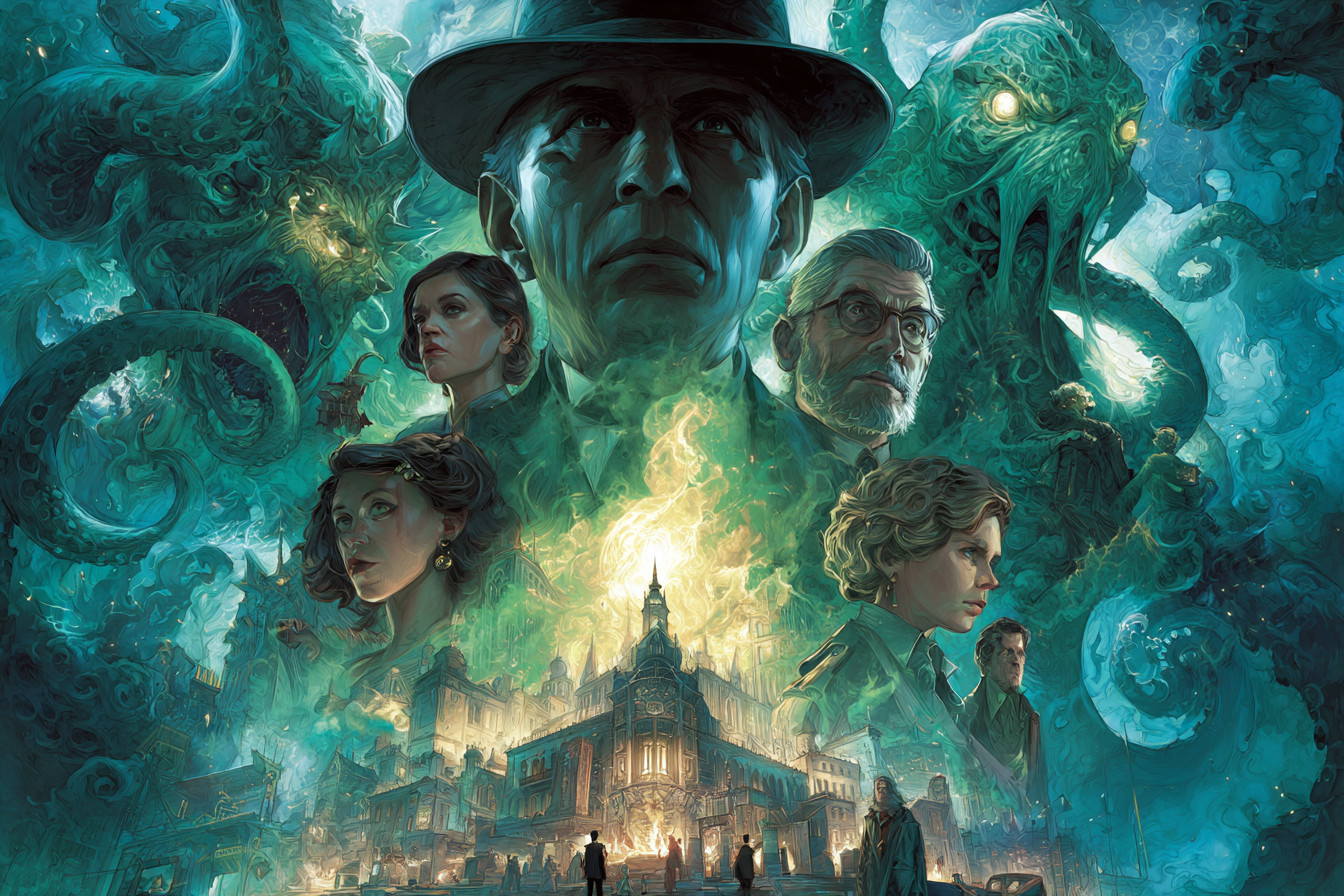

For over 30 years, I’ve spent my free time competing in the world of competitive Euro games. For the past seven years, however, I’ve been spending my free time playing a cooperative card game immersed in Lovecraftian horror. How did I go from being a die-hard competitor to a die-hard cooperator? After all, I never thought I’d give up my Euro games that focused on Victory Points (VP) and Engine-Building for a co-op card game with a similar focus on VP and Engine-Building.
It all started in 2017 at a convention in Albany. Bill, who had only attended three gaming conventions in his life, had accompanied me to this event. While I was playing a 4-hour session of Great Western Trail, Bill walked away from the table and got roped into playing a demo of Arkham Horror LCG at the Fantasy Flight booth. I finally found Bill an hour or so later, and he was totally engrossed in the game. This doesn’t happen often – Bill doesn’t get excited about many of the games I play, and he usually tolerates my hobby. But here he was – he was actually enjoying a card-and-dice game with…tentacles?!
The demo runner, a very enthusiastic fellow named Marcus, explained that we were both investigators in 1920s Massachusetts working to uncover mysteries while cosmic horrors threatened our sanity. Marcus gave me a character sheet for Skids O’Toole – a former convict with a knack for avoiding trouble. Ten minutes into the game, I was hooked. Not because of the theme – I don’t enjoy horror-themed games, and Lovecraft books aren’t exactly easy reads. I was hooked by the Decision Space.
Most co-op games I’ve tried have felt like playing group Solitaire with a thin layer of team work. Players optimize their own puzzles, and may occasionally coordinate efforts to maximise efficiency. Arkham Horror is different; it forces actual collaboration among players. Players are not just optimizing their individual resource management and action selection – they must weigh their individual survival chances against the survival of their teammates’ chances, make tactical decisions that would be unacceptable in competitive games, and sacrifice themselves for the good of the group.
As for the deck construction mechanism, I was initially reminded of Dominion. I had played Dominion extensively and loved its deck-building mechanic. However, Dominion gives you a marketplace of cards to buy during gameplay, whereas Arkham Horror requires you to build your investigator’s deck before the game begins, and you must live with the choices you made for the entire length of the scenario. This is akin to bringing a tool kit to fix an unknown problem. You may bring tools to deal with combat encounters, and find that you must use your intellect and willpower to overcome tests of intellect and willpower. The uncertainty of the problem you must address creates exactly the type of optimization challenge I enjoy.
What ultimately won me over was the Skill Test System using the Chaos Bag. Rather than rolling dice to resolve challenges, the Chaos Bag provides random results using tokens that start out numbered and eventually become filled with symbols representing growing doom and cosmic influence. Randomness exists within the game, but it is a randomness that is used to create narrative tension, rather than simply as a result of chance. When you are desperately attempting to close an otherworldly portal and pull a Tentacle symbol from the Chaos Bag that represents automatic failure, even a non-randomity enthusiast such as myself can appreciate the dramatic timing.
I purchased the Core Set that weekend, much to Bill’s dismay regarding my “collection addiction”. I played the game alone first – yes, you can manage multiple investigators by yourself, and this appealed to the same part of my brain that loves to manage complex economic engines in Heavy Euros. But it wasn’t until I convinced my regular gaming group to try the game that I saw true magic.
These are serious Strategy Gamers. We generally play games like Brass Birmingham, Food Chain Magnate, etc. Games that have zero randomness and pure information. Convincing them to play a game where Cthulhu could potentially drive them mad forever was… an adjustment. But the Group Dynamics that formed were nothing like anything we had seen in Competitive Games.
There was this moment in our third game of Arkham Horror where Janet’s investigator was on the brink of going completely insane – one more horror would remove her from the game completely. We had Clues spread out in several locations, and a clock ticking down, threatening to end the Scenario in Failure. Mathematically, the best option was for Janet to retreat to a safe area while the rest of us cleared the danger zones. Instead, she chose to explore the most dangerous area because she had the correct skills for that particular test. She pulled the worst possible Chaos Token, went insane, but uncovered the last clue we needed to move forward the Act Deck and win the Scenario.
That would be terrible play in a competitive game, but in Arkham Horror, it felt Heroic. Arkham Horror had created Conditions where Optimal Individual Strategy conflicted with Group Success, and the Tension created made the Victory feel meaningful in ways that Pure Optimization Victories rarely feel.
I was also unfamiliar with the Living Card Game model. I am used to purchasing Complete Games, not ongoing Content Releases. But Fantasy Flight’s approach to releasing small expansions that add new investigators, Scenarios, and Player Cards has worked well for how I process Games. Each new Investigator feels like another Puzzle to Solve – how do I construct their deck to maximise their Unique Abilities? What combinations of cards create interesting Synergies?
I have since acquired all the released Expansions, which Bill says proves I am as obsessed with this game as I am with my Euro Collection. He is not far off. The Mythos Packs reside on my shelf in order, and I have detailed Notes on Optimal Builds for each Investigator. My Gaming Group frequently jokes that I have transformed Co-Op Horror into Competitive Deck Optimization, which is probably true.
The Campaign Structure also merits special mention. Most games are Discrete Sessions, whereas the Scenarios in Arkham Horror are linked together in Multi-Session Campaigns, where your choices have Lasting Consequences. Your Investigators can Gain Experience and Trauma, Your Deck Compositions Evolve, and the Story Branches depending on your Successes and Failures. This is the closest Board Games come to Television Series – Episodic, yet Building towards Larger Narrative Arcs.
Mechanically, I believe Arkham Horror does an excellent job of Creating Meaningful Tension Between Short-Term Survival and Long-Term Objectives. Each Turn, you are Balancing Immediate Threats Against Scenario Goals, Your Personal Safety Against the Needs of your Teammates. The Agenda Deck Continuously Advances, Creating Time Pressure that Prevents Analysis Paralysis that Can Occur in Cooperative Games. You cannot Spend 15 Minutes Calculating the Best Option when Cosmic Doom is Literally Counting Down.
Arkham Horror is not Perfect. Some Scenarios can be Punishingly Difficult, Especially if you Draw Bad Tokens from the Chaos Bag and Everything Goes Wrong. Some Investigators Feel Under-Powered Compared to Others, and Constructing Decks Can be Overwhelming for Players Who Just Want to Play the Game. However, These Flaws Feel Minor to Me Compared to the Successful Creation of Dramatic Tension Through Mechanisms.
What Arkham Horror Taught Me is That Randomness is not Necessarily Bad Design – It is About How That Randomness Serves the Purpose of the Game. In Competitive Euros, I Want Randomness Minimized Because it can Determine Winners Arbitrarily. In Cooperative Games, Randomness Creates Uncertainty that Makes Victory Feel Earned Rather than Guaranteed. The Chaos Bag System Generates Exactly the Right Amount of Unpredictability to Create Tense Scenarios Without Feeling Unfair.
Seven Years Later, Arkham Horror Still Gets Played Regularly By My Group. Not Every Session, Mind You – It is Emotionally Demanding in Ways that Pure Strategy Games Are Not. But When My Group Wants Something that Challenges Their Tactical Thinking and Tells Compelling Stories, Arkham Horror Provides an Experience that No Competitive Game Has Ever Matched. And Yes, I Am Still Buying All the Expansions. Some Obsessions Are Worth Embracing.

Meeple Power is all about celebrating the joy of board games—great stories, clever mechanics, and big laughs around the table. We cover everything from easy-to-learn gateway games to deep strategic epics, shining a light on the creativity, community, and occasional chaos that make tabletop gaming so much fun. Whether you’re rolling dice, flipping cards, or arguing house rules with friends, we’re here to keep the game night spirit alive.